Search:

Saturday, 19 September 2015

When School-Children Asked Me How To Make A Bomb

As many students do, I spent a summer abroad doing a charity thing. Don't get me wrong, this was no posh-boy's year out, I raised pretty much all the money myself and it was via a university society which specialised in overseas aid projects.  But yes - it was one hell of a good time. I got to go to Nepal, which as a keen mountaineer at the time was a dream come true, if a little frustrating - I had a couple of thousand pounds to spend on my two months there, most of which was spent on flights, trains and directly to a school in Sundarijaal, just outside Kathmandu, and the lovely local family who housed and fed us.  Fancy actually going mountaineering in Nepal? Well you're going to need somewhere in the region of 100 times the money I had available for the project. I could see the classic summits from my books, but there's no way I was going to even set foot on them.

On the other hand, we lived and worked with some wonderful people, and helped lay the groundwork for a new school building, mostly by carrying saplings over the same two mile route up a hill and planting them to stabilise the land the school had been able to buy with, in part, the funds we raised from drunk people in Edinburgh.

But we also had a few days in the main school itself, which was incredible.  The kids were the best behaved and most intelligent you can imagine by UK standards. On my first day in the school the head teacher asked me what my area of interest was - science, and in particular physics, as you'll realise if you've read much of this blog.

So I was introduced to a class of around 30 kids, all around 14 years old (and bear in mind I'd just turned 18), and I expected to maybe help out as a bit of a classroom assistant.

"Hello class, this is Mr Robbins, he'll be teaching you science for the next hour."

Then she left.

"Mr Robbins?  Oh. Oh crap.  That's me."

So I'm left with my first, and to date, only classroom full of children who are looking at me and expecting something cool.

So fair enough, I realise, I'm kind of here as a novelty lesson, but at the same time I don't want to mess up any existing plans the teacher has.  So let's find out what they've been learning about so far.

As it turns out, a bit of everything - optics, basic electrical and electronic stuff, simple mechanics, everything you'd expect from a science class of the same age in the UK. Nothing, in particular, is a particularly important focus as far as the kids are concerned. Probably a good thing, because if they're really focussing on atoms and I start throwing quantum tunnelling into the mix just to be funky and interesting then they're all going to confuse the examiners at the end of the day.

"OK. So what do you want to learn about?"

One hand went straight up. "How do you make a bomb?" - the rest of the class seem to be in delighted agreement.

Which leaves me with a bit of a problem - because bombs are both deadly, and dead easy. There's an unspoken agreement between almost every geek on the planet that we don't generally talk about how to make bombs, because it's so damn easy to do. Especially in a country where you can buy reasonably large quantities of certain chemicals without suspicions being raised. UK, Nepal, wherever. Maybe a bit easier in Nepal in the 1990s than the UK today, but there's not an enormous difference.  And I quite like these kids, I don't particularly want to see any of them losing arms and legs, however much they enjoy my lesson.

On the other hand, there's one particular style of bomb that they can't easily make, but which has some lovely theory surrounding it. Atomic structure, chain reactions, a little bit of E=mc^2.

Yes, I spent the best part of an hour teaching kids how to make nuclear weapons.  And if anyone thinks that this is a fundamentally bad thing, I'll point out that at the time of writing a kid of the same age in the USA has been arrested for taking a home-made "breadboard" style electronic clock to school, on the grounds that it "looked a bit bombish".

Frankly, kids deserve better. I knew how to make a bomb, and had access to the materials, at around 14 too. Almost every kid of that age who can, doesn't.  Because being smart enough to build it means you're smart enough to not build it.  Arrest every kid who could and you end up with kids who aren't willing to admit they're smart, they just go and flip burgers for 20 years. And then they snap. And build their bomb.

Saturday, 7 March 2015

Scotland Calling

[The stats on this blog show the majority of my readers are in the USA, so for UK readers this post may seem to explain the obvious at times.]

We live in interesting times. The UK is a couple of months away from a general election, and we're looking at the most fractured and unpredictable split in voting for a very long time.

Since around 1930 British politics has consisted of two main parties, the right wing Conservatives (aka the Tories) and the left wing Labour party, plus lesser support for various incarnations of a middle-ground Liberal party.  We've always had other minor parties too, the far right British National Party, the Raving Loonies (a surprisingly long running "joke" party) and parties specific to the member nations - Plaid Cymru (PC) in Wales and the Scottish National Party (SNP) up here north of the border.  (Northern Irish politics is immensely complicated in its own right, I'm going to leave those issues aside for the moment.)

The last time the UK had a government that wasn't either Labour or Conservative led was in 1918, when the Liberals won. We're currently in the unusual position of having a coalition government of the Conservatives being supported by the much smaller Liberal Democrat party, but for the last hundred years or so the UK has basically been Conservatives versus Labour, and they've never seen eye to eye.

But Scottish politics has always been a bit different. We've consistently voted for left wing parties, traditionally Labour but with the SNP becoming more and more popular over the last thirty years. Since 1999 Scotland has had its own government which deals with purely Scottish matters (similar to the State v Federal split in the US), and despite being designed to prevent majority governments the SNP managed to win a majority of seats at the last Scottish election.  It should be pointed out that unlike most parties with "National" or "Nationalist" in their name, the SNP are on the left of the spectrum, generally described as social democrats - major policy splits from the main UK parties include providing free university education, a focus on renewable energy investment (Scotland currently produces over 40% of its energy needs from renewables, mainly wind and hydro), and crucially, a pro-independence stance.

As you probably heard, we held a referendum last year, asking "Should Scotland be an independent country?", which resulted in a roughly 55% to 45% vote in favour of staying within the UK, and saw an enormous turnout of over 84% of voters go to the polling booths, a figure unheard of in British politics.

During the hard-fought campaign most UK parties campaigned for a "No" vote (eg Scotland staying in the UK), and we saw the extraordinary sight of senior Conservative and Labour politicians stand shoulder to shoulder against the SNP (who were supported by minority Scottish parties including the Greens and Scottish Socialist Party).

This has caused a collapse in support for the Labour party north of the border. Now, while Scotland only return 59 MPs to Westminster (around 9% of the total), these seats are crucial to the Labour party. But now this support seems to be evaporating in favour of the SNP, who are predicted to win the majority of them at the next election.

All good for the Conservative party, you may think, but they've got their own woes in England, with the UK Independence Party threatening to take a lot of their support.

So we're in the odd situation of a predicted general election looking something like this:

Conservatives - 286 seats
Labour - 280
SNP - 38
Lib Dems - 24
Others (~6 parties) - 22
(Source - electionforecast.co.uk, figures at the time of writing)

In this situation no party has a majority, and under UK law the largest party must try and form a coalition. The SNP are opposed to Conservative policies to such an extent that they've already ruled out any kind of support, the Conservatives would have to gather the support of most of the Lib Dems and "others" to form a government.

If this option fails, Labour could form a government with the SNP, although the SNP have already ruled out a formal coalition, preferring to offer support on the basis of "confidence and supply" - if Labour propose policies the SNP support, they'll vote with them, but there's no guarantee.

Or, of course, there's the option of a Con/Lab coalition, something we've only seen before during wartime, and could cripple the support for the two main Westminster parties for years to come. This is generally seen as unlikely, but as we get closer to the election more and more people are putting it forward as an option.

So we've reached the weird point where the balance of power in the UK government could be held by a party who do not want to be part of the UK government.

So what's the SNP position on the continued fight for Scottish independence? It's not 100% clear. Their statement immediately after the referendum was that they would "continue to work for Scotland's interests as part of the UK", and it would clearly be a bit odd to hold referendum after referendum until they get the "right" result, it would make a bit of a mockery of the process.  At the same time, however, the close result last year and rise in SNP support has spooked the main parties to the point where they may never agree to another referendum anyway.

I suspect we'll see a gradual slide toward a federal UK, with Scottish, Welsh and Northern Irish parliaments gaining more powers and Westminster slowly being relegated to dealing with only UK-wide matters such as foreign policy and the military. This does leave the obvious gap of an English parliament, although the shout of "English votes for English matters" has become common ever since the referendum

After winning a vote to keep Scotland as part of the UK, the UK government now feel their greatest threat is Scotland - and the Scots, having voted to remain, find they have flipped the tables and have a new-found and far more powerful role at Westminster.

Who "won" the Scottish independence referendum? I'm really not sure, but the next five years are going to be interesting.


Thursday, 29 January 2015

Spontaneously Exploding Pint Glasses

Right, time to move away from the beer and back to the science - but I'm going to ease myself into it with a post on pub-based science.

This one has Glenmoray in it.

I have to admit to a whiff of paranoia when I
picked this glass up specifically for this post!


The classic British pint glass, the "nonic", is in my humble opinion one of the great pieces of design. It holds beer, you can stack them when empty (making a bartender's life so much easier), and the little bulge both improves grip and prevents the lips of two glasses from coming into contact, a little hygiene feature that nobody usually notices.

And they're tough, seriously tough. You can plunge a nonic into icewater straight from the glasswasher (at around 70C) and it'll cope with the thermal shock. You can stack them 30 high and they'll survive (not recommended for safety reasons, but you can).

The reason for this toughening is in the heat treatment they go through when they're manufactured. Each glass is slowly heated to around 720C and then rapidly cooled with chilled air. As the glass cools the inside (actually inside the glass, not "inside" as in where you put the beer) cools more slowly, leaving the whole structure under compression - it literally squeezes itself, resulting in a tougher glass that won't crack easily, and when toughened glass does break it does so in spectacular style, shattering into hundreds of small cubes and relatively few dangerous shards, meaning there's a much lower chance of serious injury due to accident or malice.

There is a downside to this heating process though, and it's all down to something called nickel sulphide (NiS).  This is a common contaminant in making glass and is very tricky to remove, especially when you're trying to make reasonably cheap glasses for pubs. It exists in two forms, or "phases", alpha-phase and beta-phase. The beta-phase is the everyday form, stable at normal temperatures, with the alpha-phase being stable at temperatures over 715C - crucially, this is just under the temperature required to harden the glass.

So when we rapidly cool our pint glass and it hardens we can end up with little bits of alpha-phase NiS stuck inside it, squeezed into not popping back into beta-phase because it would have to expand by about 3% to do so.

Now these "NiS inclusions" as they're technically called, will eventually pop back into the beta-phase, but it can take years. When they do though, they can cause an enormous amount of stress - up to 125,000 pounds per square inch, concentrated into a tiny area inside the glass. For comparison, the water pressure in the Mariana Trench, the deepest part of the oceans, is "only" 15,000psi.

This is easily enough to cause a crack to shoot through the glass at supersonic speeds, blowing the entire glass to pieces.

It's not a predictable effect, it can happen at any time. A slight shock to the glass (literally just flicking it with a fingertip in the right place) or even an ultraviolet ray from the Sun can set it off. Or it can just happen spontaneously, and there's plenty of reports of people's pint glasses simply exploding while sitting on a table. It's an interesting complaint to deal with as a bartender, in a decade behind bars I had to deal with incredulous customers twice and saw it happen to unattended glasses a couple of times.

The failure rate is small enough to be acceptable in pubs, especially given the other safety benefits of toughened glass, but this is a serious problem in glass being used for construction, such as modern skyscrapers and funky new bits of architecture, and is known as "glass cancer".


I believe this video is probably the result of a NiS inclusion - I'll buy a couple of pints for the first bartender to catch it on CCTV, statistics suggest it must happen weekly in the UK alone.


Further reading:
Nicely readable detail: Glass Breakage & Nickel Sulphide Inclusions  

NSFW but we're talking your-pint-exploding language: Real Life Account


Friday, 30 May 2014

Armageddon For Brewmeister

Brewing is huge in Scotland, both in terms of popularity and the sheer number of breweries producing some truly wonderful beers. We're blessed in many ways, with enormous tracts of ideal land for growing barley and a plentiful supply of crystal clear water combined with mineral geology that is second only to Burton Upon Trent's legendary supply.  The industry has a worldwide reputation which is close to that of our whisky industry.

The business has changed over the years - the post-WWII period were dark times, and the industry went into decline, but over the last few decades many new breweries have sprung up, from the (literally!) archaeological origins of the Williams Bros, through the more traditional such as Stewart's and Harviestoun, and even tiny little one-man bands like Barney's, working from a little room in the centre of Edinburgh.

And, of course, there's the big bad punks of the world, Brewdog.  This relative newcomer have caused a bit of a stir with their anarchic marketing and PR, taxidermy bottles and experiments at the edge of what can be called "brewing", producing mouth-puckeringly bitter IPAs, annoying their critics with super-low-ABV beers that still taste of something, and most notably getting into an arms race to produce the "world's strongest beer" by using freeze-distillation to remove most of the water, leaving behind "beers" which are in excess of 50% alcohol.

And now to Brewmeister, who are trying do do almost exactly the same thing.  Same "anarchic" marketing, same fringe-brewing techniques, and a couple of beers claiming to be 60%+.

Only there's a huge problem.  Brewdog know what they're doing.  Brewmeister...well the kindest thing I can say is that they're incompetent.

After suspicions were raised by many people who had tried Brewmeister's Armageddon, a self-style 65% ABV "strongest beer in the world", the man behind the excellent Beercast blog teamed up with Edinburgh craft beer pub The Hanging Bat and had a few tests run, on both Armageddon and Brewmeister's follow-up beer, Snake Venom.  The results (to the nearest percentage point) are horrific.

Armageddon
Claimed ABV: 65%
Tested bottle: 23%

Snake Venom
Claimed ABV: 67.5%
Tested bottle: 41%

 Rich's full blog post on the matter can be found on his Beercast site and is well worth a read.

There's so many problems here it's difficult to know where to start. Firstly there's the fact that declaring the alcohol content of drinks is mandatory, and you have to be accurate to within a percentage point.  Get this wrong and you not only face legal action, but your customers (which for a brewery includes pubs and off-licences) could end up in court themselves.  It happened to a friend of mine with a bottle of vodka that had been adulterated, the court ruled that the only defence was testing each drink with a hygrometer, which no pub has ever done and is completely impractical.

Secondly it reveals, at best, a shocking lack of control in their brewing and freeze-distillation process.  It could have been done intentionally, but I have seen no evidence of this.

Thirdly, a complete lack of control shows that this isn't experimental brewing to push the limits of the science, it's what respected US beer blogger Garrett Oliver calls "clown brewing" - simply an attempt to garner publicity through shock value.  This is from a company who's stated intention is to "deliver you to drunksville", a concept that is firmly rejected by every other Scottish brewery, no only because it breaks alcohol marketing laws but also because it's tacky, stupid and is counter to just about every principle brewers pride themselves on.  You can't taste beer properly if you're utterly smashed.

Would you believe it can get worse?  It gets worse.

 Brewmeister have replied to some of these issues in a few paragraphs in the middle of a bigger blog post.  Their implied solution to the problem?  Adding industrial ethanol.

Seriously, if their beers aren't up to ABV after brewing and then freeze-distilling then their first suggested solution isn't changing the label on the bottle, but pouring in neat alcohol.

They seem cagey on whether they've ever actually done this, but the very idea is farcical.  If you do that it's not beer anymore, it's hardly even an alcopop.  It's just industrial alcohol flavoured with an overly-expensive malt extract, and frankly that sounds foul.

 It's not brewing.  It's not even clown-brewing, it's just...well, I don't know what it is, but they need to hand their reputations in and try not to let the jugs of alcohol hit them on the arse on the way out.  They're doing unimaginable harm to the Scottish brewing industry by simply existing and the sooner they fall by the wayside the better.


Tuesday, 20 May 2014

What Am I?

(Random rambling brought on by reading Why Would A Fundamentalist Christian Become An Atheist)

OK, so I'm an atheist.  But I hesitate to describe myself as such.  After all, I don't describe myself as a non-stamp-collector (although, as with religion, I gave it a go as a kid),  I don't find defining myself as a lack-of-a-quality to be useful in any way.  I could try capitalising Atheism, and joining other Atheists to talk about Atheism, but if Twitter is anything to go by this ends up being the same arguments going around and around and around...in fact the best people to talk to on Twitter about atheism tend to be the theists, as they are generally more likely to have a grounding in the relevant philosophy, Pascal's Wager and so on and so forth.

I'm certainly not a "New Atheist", they're far too pushy for my liking.  Religion is (currently) a part of humanity, we can't bully people out of it, and there does seem to be a psychological need to find an answer to "but why", which I'm guessing is why atheism and science, particularly maths, physics and cosmology tend to be associated when there's actually no logical link other than the fact that science classifies "god" as outside its remit.  On this count, living in a world where people disagree, I'm a Wheatonite.

Nor would I describe myself as an agnostic - I don't believe any current definition of "god" is good enough for me to accept as a possibility, and the standing "bigger than the universe" criterion means we won't have a good enough definition until we're finished doing science, which won't happen in my lifetime at the very least.  On this count I'm certainly an ignostic, but I find that even less satisfying as a definition than atheism, which at least defines what it is...or isn't, at least.

OK, so I'm a human, so what about Humanism?  Even then, it's a group of people who have got together and decided what a Humanist is, and written down the rules, and are probably still arguing over them.

I did toy with the idea of being Vulcan - yes, like in Star Trek - there's a lot to be said for the mentality, but I happen to like laughing till I cry and feeling overcome with beauty and all the other stuff.  Ditto Jedi and Avout - I may have bought the monk-style dressing gown, but I'm not going to buy into it 100%.


So I'm just going to stick with being Geoff.  I reserve the right to change my mind.  Your results may vary.


I'd recommend you try the same.  Not being me, of course, just being you.  You can try being me if you want, but trust me, it's just confusing.  I'm actually very happy with it, but it does (in my experience at least) take nearly 40 years of training to be me.

Sunday, 11 May 2014

How To Prove Einstein Wrong

Physics exists on a spectrum, from the incredibly rigorous, through the vague and "hand-wavy" to the borderline crackpot - and there's plenty of room at the bottom.  For some reason physics attracts the crackpot, there's no shortage of claims of perpetual motion machines, "proofs" of god and the great favourite, "I've proved Einstein wrong" - ask any physicist and you'll probably find they've received plenty of emails along those lines, almost all of which "aren't even wrong", a very specific physics insult used for hypotheses which aren't testable, well defined, or rely on the Universe doing things which would break every known and tested physical law.

Why does Einstein get singled out? Why don't we see claims of "proving Planck wrong" all over the internet? Or even Arthur Stanley Eddington, who despite being an excellent physicist had some exceedingly crackpot ideas himself and is very easy to prove wrong - and yet returns zero results?  I'd suggest Einstein's continuing fame is a major factor, everyone wants to beat the person at the top.  Add to this the fact that there's some known "issues" with Relativity, specifically the Dark Energy and Dark Matter problems, and he becomes the prime target.

But whilst the majority of attacks on Relativity lie firmly in the realms of crackpottery, "proper" physicists continue to examine, reformulate and test the theory.  A great example is Mike McCulloch's work, which I've spent some time getting my head around recently.  He's a lecturer in geomatics, the study of measuring positioning in space which, while technically and historically is a branch of geography, is conducted using GPS and other satellite based systems these days, which means you're working almost exclusively in Einstein's realm, the mathematical model of relativistic spacetime.

The theory he's developing is called "Modified inertia by a Hubble-scale Casimir effect", or MiHsC, and it's a fantastic example of a proper, non-crackpot, approach to the problems in modern cosmology.

The Problems

There are three main issues with the basic theory of Relativity, one from a theoretical basis and two brought up by observation. 
  The first is the simple fact that in the last fifty years we've not been able to mesh the two main theories of physics, General Relativity and Quantum Field Theory.  Both work, and for all everyday purposes we can pick whichever theory we need, quantum theory for anything very small (such as the subatomic experiments being conducted at the LHC) and relativity for the big stuff, like the orbit of planets or the behaviour of clocks on satellites.  We can even use them at the same time, such as the relativistic change to atomic clocks on satellites (which GPS relies on) or the way the LHC can give protons an bigger "punch" and create much heavier particles like the Higgs.  But push things too far - like the center of a black hole or the behaviour of the universe in the first tiny fractions of a second and things break down.  The graphs go off the scale, the theories don't mesh, and we end up with nonsensical results - that kind of thing makes a physicist's brain itch. A bigger theory is needed.
  The other two problems are both brought about by observation - if you take the simple, original version of relativity then it doesn't match what we see in the sky - galaxies rotate too quickly (known as the "Dark Matter" problem) and the universe is not only expanding, but the expansion is accelerating, which is the "Dark Energy" problem.  Don't let these names fool you, they're both really placeholders for whichever correction-or-replacement is needed in the current theory.
 

The Theory

MiHsC is a whole new approach to the origin of mass - specifically inertial mass.  It may surprise you to hear, but there's lots of different kinds of mass. The two we're looking at here are gravitational mass (the one that gives something "weight") and inertial mass, which is what makes something big more difficult to move.  The two are thought to be the same thing, something referred to as "the equivalence principle", but note that this is just a principle - plenty of experiments have been performed to check this principle, from Galileo dropping cannonballs from the Pisa's tower to the Apollo 15 astronauts dropping a hammer and feather on the Moon.  If the equivalence principle holds then dropped objects will always fall at the same speed - the inertial mass will always match the gravitational mass perfectly.  But these experiments aren't conclusive - we've not tested it in every regime, there's plenty of wiggle room for a difference to be found.
  What McCulloch is proposing is a new idea for an origin of inertial mass, and this could potentially result in the slight changes in behaviour at low accelerations, which could explain Dark Energy and Dark Matter without having to discover new particles or new energy fields, something which has so far eluded experiments.

This new origin is based on something called the "Unruh Effect" (in itself, not a proven concept, but a well developed and reasonably testable theory), which predicts that an accelerating object will "see" a field of radiation, in effect space "pushes back".  This already sounds like a form of inertia, and McCulloch develops this idea to look at what happens at the extremes.  The radiation pushing back must have a wavelength, and as the object accelerates faster the wavelength must be shorter, in the same way the Doppler effect makes a police siren sound higher and higher pitched (ie a shorter wavelength) as it accelerates towards you.  At the opposite end, for very low accelerations the wavelength must become longer and longer...which eventually gives us a bit of an issue. 
  The length of a wave can be limited - you can't have very long waves in small harbours, to steal his example, if there's a barrier of any kind then there's a limit to the wavelength, and we have a very considerable barrier at the largest scales, the "cosmic horizon".  The longest wavelength that can be part of the Unruh effect, he claims, is twice that of the diameter of the observable universe, in other words two nodes, like a guitar string being plucked with no harmonic.  To be longer than this the wave would need to originate outside our universe, to have started before time itself started, which is impossible.  This means that there's a limit to the Unruh effect at low accelerations, which means a limit to the inertia of an object - very low forces no longer perfectly obey Newton's laws of motion, there is a minimum acceleration possible, which is all starting to sound a bit like quantum theory.
 
Some physics-equivalent of back-of-an-envelope calculations shows that this could (to within an order of magnitude or so) provide the basis for Dark Energy - as the universe expands the cosmic horizon changes, meaning our "quanta of inertia" drops, leading to a feedback loop causing cosmic acceleration.
  Again, a rough application to galaxies shows that if inertia is reduced at very low accelerations - the outlying edges - then gravity would seem to have a larger effect than expected, which looks just like the solution to the Dark Matter problem.
 
So it's an attractive theory.  There's a realistic mechanism, it makes predictions which are testable within the limits of current or near-future technology and observations, and natural solutions to the two big problems within Relativity seem to just "fall out" of the theory.

Putting my "realistic" hat on there's plenty of pitfalls - it relies on an unproven effect and it's still at the "orders of magnitude" scale of development, the cosmology equivalent of a sketch.  But it's a recognisable sketch and it's a sketch doesn't rely on disproving the existence of metaphorical paper and pencils.  It doesn't prove Einstein wrong, it simply provides a slightly bigger picture which includes Einstein's work, but with subtle changes to make the limiting cases behave in a realistic manner - precisely what Einstein did with Newton's work in fact.

And so what if he does eventually turn out to be wrong?  If McCulloch didn't propose it then somebody else would eventually come up with the idea, so there's no time wasted, and the payback if he's right is huge, yet another "new view of the universe" moment.

And if we do want some crackpot in our theory? Well, it does raise the idea of blocking inertial effects in some way...


Links

Physics From The Edge - Mike McCulloch's Blog
arXiv paper - Testing Quantised Inertia On Galactic Scales
Mike McCulloch on Twitter


Thursday, 23 January 2014

What's It's Really Like To Be Under UK Government Surveillance

Our topic this evening, ladies, gentlemen and sleeper agents, is the world of government monitoring of their citizens.

There's clearly a lot of this in the news, with both Julian Assange and Edward Snowden playing a modern day Robin Hood and Guy Fawkes, and especially with the revelations of the extent of US and UK monitoring of their own civilian population.

Nobody seems surprised, of course, we all suspected it was going on (to various levels of tin-foil-hattery), but everybody's clearly annoyed that they've been covering up what we all presumed anyway.

At best, that's a big waste of taxpayer's money.

But let's flip it around, look at it from another angle:  My life since I was 16.


For the last 22 years of my life, I've let the UK government (specifically the military/intelligence networks) have privileged access to my life.  I signed up for a scheme that was (probably still is) called "positive vetting".  I'd applied to join the RAF and they obviously need to be able to check on applicants in some depth.  I essentially signed a bit of paper allowing them to spy on me to various levels without the whole court order thing required between the police and civilians, for example.  I don't remember the detail, but it was things like being allowed to monitor my communications (this was early 90s) and interview people who knew me.

Crucially, it doesn't expire.

My RAF career fell through just before I'd formally signed up and just after they taught me to fly, which was both disappointing and utterly exhilarating. But at no point since have I cancelled my permission for them to vet me.  I've never really felt the need to - bear in mind I was applying to this organisation knowing "fiery ball of death" was a realistic (but hopefully avoidable) part of the career ladder.

So for the last 22 years of my life "the establishment" have had legal permission to monitor me far beyond the levels revealed in the Snowden leaks, and I've been no angel.  I've not been an angel on the phone, at work, and I've not been an angel on the internet a LOT.

To be fair, I've never suggested actually overthrowing the government (in fact, I had to sign another piece of paper promising not to), but I've certainly had a good old bitch about various parts of the "establishment" over the years.

I'm into physics, and have done more than my fair share of searches on nuclear physics.  See also my interest in long term energy policy which involves the details of nuclear reactor design.

I'm a hacker.  I describe myself as such, specifically a white-hat but just being a hacker may raise a flag.  I'm interested in cryptography and the state's capabilities and/or denial of such. Quantum computing is a related interest.

I've smoked the odd joint. I've been involved in plenty of pub scraps and pickpocketings over the years - most of which I'm proud to say involved either people being mates at the end or thrown into police vans respectively, but working as a pub licensee is a really good way to stay on the radar.

My interest in science leads me to the science/religion debate, and that leads me to comparative theology, which ties in nicely with the current themes of terrorism and religion.  I've got one particular Muslim friend who loves cracking terrorism jokes with me. 

I'm quite honestly proud that the all-time most popular article on this blog is one of the top Google results for "how to destroy the universe."

You can see how that kind of thing can be read the wrong way.


I've got mates who are police officers, civil servants and serving members of the armed forces.


If people are going to be interrogated for their internet activities then I'm a prime candidate. 

But it's never happened.  

OK, if you want to get conspiratorial then my police/government/army mates are spying on me, but to be honest it's worth it if that's the case, they're genuinely lovely people.

Saturday, 21 December 2013

Why Internet Filters Are (Mostly) A Dumb Idea

Here in the UK the Conservative-led government has just introduced, to much fanfare, internet filters.  The idea is, of course, to "protect the children", that classic "vote winner" in the lead up to a general election.

Of course, well implemented filters do have their place.  Workplace networks are a good example, they're used to protect sensitive data and to protect against malware.  In the home, however, it's a slightly different story.

The filters that have been introduced are at the "ISP level", meaning they are run and implemented by O2, BT and the rest of the main household providers, and the settings are (by default) the same for every household in the country.  It's not some sort of government mandated censorship scheme, whoever is paying the bills is able to turn them off and browse the entire internet to their heart's content, so there's no real "but we're adults" argument.  The problem is that it doesn't only fail at its main purpose of "protecting the children", it may actually make things worse.

The internet is, like the rest of life, a big bad world containing plenty of things that children shouldn't be exposed to.  Young children using the internet should be supervised, and older children should at least have had a little bit of education in the potential dangers and how to handle them.

Even if these filters worked well (which they don't, it's still a trivial exercise for a 10 year old to find porn if they're determined to), you can't replace being a parent with a list of bad websites.  The filters are incomplete and always will be, and telling parents that they will protect children is akin to telling them their kids can drive a car as long as they're wearing a seatbelt. 

What the government should be doing is teaching parents about hacking.  Firstly, just how easy it is to work around these filters, and secondly (and most importantly) that the most effective form of hacking ever devised is called "social engineering" and has almost nothing to do with computers.  If you wanted to break into Company X's network then you could either spend days running various attack scripts, all of which will probably fail, or you could simply start phoning around the employees, claim to be from an IT contractor, and sooner or later one of them will hand over their login details.  It happens every day.

Children won't be protected by filters, and suggesting that it's even possible is dangerous and misleading to parents.  To protect their kids parents simply have to use a little social engineering - in this context it's more often called "talking to your children".  You're never going to stop a teenage boy finding porn on the internet, but what you can do is make sure that when they do find it they know what they're looking at - a commercialised parody of what the average sex life is actually like.  You can't prevent your daughter receiving a phishing email, but you can make sure that she recognises what it is and doesn't respond to it.

Imagine you'd never been allowed to cross a road until you were 18, what would your life expectancy be?   You don't stop children crossing roads, you teach them to do it safely, and that's exactly how we should be treating the internet, not with crude, politically motivated "solutions" that are worse than nothing.

Sunday, 15 December 2013

Robotic Cat Syndrome - An Owner's Experience

Our much loved cat, Henry, died a couple of weeks ago.  We had him euthanised because he had Robotic Cat Syndrome (RCS) and had reached the stage where he had trouble doing everyday cat things.  We're pretty gutted to be honest, but hopefully our experience can be of some use to others.

RCS is a fairly rare condition which only affects cats in the North East of Scotland, roughly the triangle formed by Aberdeen, Aviemore and Inverness.  The only real study of the condition and anecdotal evidence from our vet suggests a hundred or so cases have been found.  It's most likely a viral infection picked up from the bird or rodent population, and causes a slow loss of motor skills, typically over the course of a couple of years.

A disclaimer at this point - I'm not a vet, the only biological science education I have is a first-year biology course I did at university (Feynman's "map of a cat"), and I've not even been able to read the only peer reviewed paper on the subject because it's behind a paywall (insert rant here). This isn't veterinary advice, it's the experience of one owner. If you have any kind of concerns about your cat then please ask a real vet, not me.  DON'T PANIC. RCS is rare and restricted to a fairly small area. And it's not the end of the world, see below.

We first found out Henry had RCS because we took him to get his back claws trimmed.  We thought he was having trouble scratching because they were too long, but the vet immediately spotted that he was moving strangely.  I grew up with dogs, so I'm not used to cats, but a cat-fluent friend had also suggested something wasn't quite right.  He was holding his tail out a little stiffly and his back legs weren't quite as fluid as they should be.

Over the next six months or so he lost much of the strength in his back end, with the thigh muscles visibly wasting.  He stopped jumping up on objects pretty much in order of height - he'd previously been able to jump a good 4ft+ from a crouch, but six months after the first suspicion he was limited to the couch and (usually) my favourite chair.

He then gradually deteriorated over the next year, with movement becoming more and more awkward and moving forwards towards the head.  He was still capable of quick movements, as evidenced when he was startled by a friendly German Shepherd which snuck into the house, but that was clearly quite adrenalin charged, most of the time he adopted a careful plod which gradually got slower.

At no point did he seem to suffer from any mental problems - he was clearly a little frustrated, but he didn't exhibit any of the confusion that have been reported in some RCS cases.  Nor do we think he was in any great pain at any point.  When we last took him to the vet, about two weeks before he died, the vet didn't believe Henry was in any pain, but agreed with us that he was starting to lose his basic "being a cat" functions.

What You Can Do To Help The Cat

Ask A Vet. Ask A Vet. Ask A Vet.

Other Things You Can Do

Our vet prescribed Metacam, a drug similar to Ibuprofen, but for cats. Please, go with the proven veterinary pharmaceuticals, "alternative veterinary medicine" is designed to make you feel better, not the animal.  Metacam seemed to make Henry far more able to relax and he enjoyed it as a "treat" straight from the oral syringe.

Help them scratch/wash.  They can't reach up with their legs easily, so Henry seemed to enjoy a good firm rub with my palm.  I'd also moisten my hands with a little water and stroke him firmly to clear any matted fur.

Keep them active.  It can't hurt.  The cat finds moving difficult, so it will move less and lose muscle tone, which means moving is more difficult...if the cat enjoys chasing string or whatever then encourage this.


Don't Confuse It With:

Lyme disease & others - RCS does not make the cat sick (eg feverish, vomiting, loss of appetite).

Arthritis - The symptoms are similar, consult a vet.


Henry is buried in his favourite spot by the shed.

He is now more powerful than the mice can possibly imagine.


Tuesday, 15 October 2013

What "What Doctors Don't Tell You" Don't Tell You

As anyone who follows me, especially on Twitter, will be aware, there's been a bit of a fuss recently regarding the magazine "What Doctors Don't Tell You"  (WDDTY).

I've got enormous concerns about this magazine.  It's not simply an "alt-med" (alternative medicine) magazine devoted to home-grown treatments and alternatives to drugs.  It's actively telling people that homeopathy and various supplements are realistic treatment alternatives for conditions such as HIV and cancer, and that vaccines are dangerous and should be avoided.  Frankly I look forward to the days (around a decade from now) when children who have suffered life-changing measles infections bring their first legal challenges against the parents who decided they shouldn't be vaccinated.

However, there's always two sides to a story.  There is indeed a place on the magazine racks for an alternative health magazine.  I've been accused of both "moaning" and "bullying" for my anti-WDDTY attitude.  To counter this I've laid down a little challenge on Twitter: write an article that WDDTY should be about.  Not scaremongering, real criticism of the "medical establishment", just to prove that WDDTY could, if they wished, produce a responsible and useful magazine.

What Doctors Don't Tell You
One of the greatest challenges facing the medical establishment is the gradual failing of antibiotic treatments.  These were, when first discovered, one of the greatest human discoveries of all time.  Simple infections killed many people, from a simple boil to meningitis.  Any bacterial infection that the body couldn't handle had a high chance of killing you.  The discovery of antibiotics, penicillin and the like, was to change all of this in a manner which was frankly miraculous to anybody living at the time.  The equivalent today would be a cure for cancer, HIV, malaria, 'flu and car crashes all in one.

Penicillin was so useful, and so difficult to produce, that the urine of patients given the new wonder-drug was even filtered so the excess penicillin they excreted could be recovered and given to another patient.  It was, I repeat, miraculous.  I don't use that word lightly, what with not believing in god and miracles and all.

But we're facing a big problem.  It's not working any more.

Penicillin, the original drug, is of very limited use these days.  It has very little impact on most of the bacterial infections it used to cure.  There are very similar variants that have been developed - Amoxicillin, Dicloxacillin and lots of other things ending in "cillin", but they're still all just a symptom.

The problem is something else that appears to be contentious in the world of science: evolution.

The problem is, if you use a drug that kills 99% of germs then you're left with the 1% of germs the drug won't kill.  And then that 1% keeps breeding until there's as many as you started with.

This is the reasoning for all of the stern warnings on the antibiotic packets about finishing the course.  Yes, you feel better half way in, that's because half of the bacteria are gone and your body has a chance to catch up on the whole "immune system" thing.  If you stop taking the drugs, however, all you're doing is letting the drug-resistant versions (which have survived so far) take over.  It's like the 1940s USA dropping a nuclear bomb along with millions of leaflets on how to stop nuclear bombs exploding.  Sure, most of the leaflets will burn up, but one will survive, making all of your research null and void.

So if there's any criticism of the medical "establishment" to be made, it's that they've squandered an incredibly valuable resource.

Why did they do this?  It's partly simple human nature: we feel better, so we stop taking the drugs.  There's also strong anecdotal evidence to suggest that antibiotics have been over-prescribed, simply dished out to patients who have a bit of a cold and go to their doctor demanding the "miracle cure".  The fact that they have precisely zero effect on viral infections like the common cold seems to be lost amongst the sheer need to get rid of a demanding but would-get-better-anyway patient.

Antibiotics have been used as placebos over the years, because of budgetary pressures on GPs.  That's something which doctors won't tell you, because they don't have the time and money to discuss it.  They have to save the money for patients with advanced cancer who insist their "vitamin C tablets will deal with it, and by the way, can I have some more morphine?"

Friday, 11 October 2013

The Rocket Engineer's Song


 With apologies to The Corries and "The Bricklayer Song"
(Their far funnier version is at the bottom)


Dear Sir, I write this note to you
to tell you of my plight,
for at the time of writing it,
I'm not a pretty sight.
My body is all black and blue,
my skin a yellow/grey,
and I write this note to say
why I am not at work today.

While working on the stage two link
my safety rope was sheared,
and letting go at such a height
was not a good idea.
The Team 6 Chief, he wasn't pleased
(he is an awkward sod)
he said he'd have to cancel launching,
"due to FOD".

But in his haste to cancel launch,
he got the wrong codeword,
or as he claimed in court last week,
CAPCOM just misheard.
Either way, result the same,
it left me out of luck,
the countdown clock hit zero,
I knew then, I was fucked.


The engines fired, the bolts went bang,
umbilicals fell like lead,
and clinging to a Saturn V
I started up instead.
I rose up with the rocket,
assuming I was dead,
and ten feet up I hit the bloody gantry with my head.

The force of this collision,
half way up the rocket stack,
caused multiple abrasions,
and a minor heart attack.
I clung on tightly to the ship,
my body wracked with pain,
then "oh here comes the crew ramp"...
...bloody gantry one again.

I had no choice at this point,
(let alone much hope)
I put my faith in Newton
and let go the safety rope.
My body it just tumbled,
as helpless as the rain,
by some dumb luck I met the bloody gantry once again.

Crumpled on the crew ramp,
I thought I'd passed the worst,
but rocket exhaust rained down on me,
I really must be cursed.
The surgeon thinks I should be dead,
and I can only say:
I hope you'll understand why I am not at work today.


(The real version)

Monday, 7 October 2013

LSE "Jesus & Mo" Row

As always at this time of year, student unions up and down the country are trying to convince both students and their parents that "they're doing something about something", and this year the London School of Economics (LSE) is at the centre of it.

Students from the Atheist Secularist And Humanist Society (run under the auspices of the LSE's Student Union), as usual, held a stand at the Fresher's Fair.  Two members wore T-shirts displaying a cartoon from Jesus & Mo, a popular webcomic.  Complaints were made, and the Atheist Society were asked to cover the shirts.

And now there's a massive row about it.

So lets get a few things out of the way:

Islam prohibits images of The Prophet Mohammed (peace be upon him / may The Force be with him).  The intention of this rule is to prevent idolatry - for example, what if there's a picture of Mohammed where he has big ears and another where he has small ears, which is true?  It's the kind of thing that leads to schisms, and the world has quite enough of those already.  Note that this prohibition applies to Muslims, not worldwide.

Jesus and Mo isn't some crass piece of offensive nonsense.  It's a legitimate and fairly gentle piece of religious satire.  They address the question of representing the Prophet, claiming they use a body double, which is fair enough.  There's not even a question of copyright here, the cartoons are licensed under a Creative Commons licence.

A student union is, usually, a private club in the eyes of the law.  They have the right to ban within certain rules - students can't be excluded on grounds of race, religion or sexuality for example, but this doesn't amount to entirely free speech on these grounds.  Neither the LBGT Society or the Heterosexual Society (if there is one) are likely to be able to show their own particular brand of porn for example, even if it's an 18+ venue and the porn is perfectly legal.


So...the students had a right to wear the T-Shirts, the Student's Union had the right to insist on them covering it up as a condition of entry, end of story.  In the absence of any legal challenge to the matter, that's the end of the argument - there is no censorship issue, as they're only preventing something being said on Union property.  Just because the Guardian won't print this post it doesn't mean they're censoring me.  The students are free to wear the T-shirts anywhere else they want.

But, of course, these arguments tend to have a life of their own,  and everyone wants to weigh in.  I've already had two vigorous discussions with people on Twitter who disagree with me almost entirely, despite us all holding the same atheistic views otherwise.  So here's my view on a few aspects:

Question 1: Were the students right to wear the T-shirts?
I have to acknowledge that Jesus And Mo themselves say it isn't Mohammed, but I've not heard this defence presented in any way.  As an independent observer it looks very much like they're simply trying to cause offence, and in a very targeted way aimed at one particular religion.
  It's possible that they weren't even aware of the potential for offence and the reasoning behind it, but frankly if they weren't aware of the "no pics" rule in Islam then they probably need to study the subject they're rejecting a little more. 
 If they wanted to challenge the "no pictures" rule then they can do it without displaying a picture.  A shirt reading "There are no gods, and Mohammed is not a prophet" does much the same job without being so directly offensive, but even then it's singling out a particular religion - does that mean that Christianity is less liable to criticism from Atheism?  Would singling out Hindus instead be a better idea, because they have more gods and are therefore a more "legitimate atheist target"?
  The job of atheism is to challenge the initial precept that there is a god, religions themselves voluntarily lump themselves together by founding their beliefs on there being a god or gods.  Atheism doesn't need to attack Islam, Sikhism or any other religion to do its job, the argument is that "there is no god" and if it's made well enough then all religions will be equally hoisted by their own logical petards.

Question 2: Were the Students Union right to ban the T-shirts?
As with question 1, they're certainly within their rights.  Was it a sensible idea however?  Well, that depends on why they did it.  If they were expecting to get into the papers and throw their name around a little then yes, mission accomplished.  If they were trying to "protect their students" however, then it's a very different matter.
  This is a university.  The very point of which is to take some rather nerdy people and prepare them for life.  The may be "little darlings" in the eyes of some, but they have to learn to live in the real world with people who disagree with them and learn to stand their ground.  This applies just as much to your Pakistani girl from a cloistered religious upbringing as your public schoolboy who's living in a hall named after Pater.
  Student Unions do have a duty of care to their members, but part of that is allowing them to fight their own battles.


Wearing the T-shirts was a mistake.  The Atheist contingent were either very naive, or they set out to shock, quite possible hoping for publicity as a result.  But they're simply telling their "target audience" to fuck off.  If atheism is all about telling religious people to fuck off, then fair enough, it does the job, but that not any part of atheism I want to be part of.

Banning the T-shirts was also a mistake.  It was nothing illegal.  It wasn't inciting racial hatred, it wasn't threatening anybody.  It was just a particularly crass and badly thought out piece of "shock-jock" atheism.  The Union should have just told Whoever Complained to use the standard student arguments of pickets, protests and the like, let the student body decide before handing the matter over to a very few elected officials in the Union.  A vigorus public argument, no kicking or spitting, is a good thing, especially when you're meant to be learning about life.

In fact, banning the T-shirts has turned this from an argument between the Atheist Society and the Whoever Complained Society of LSE, into a big argument with people claiming the free speech of the UK is at stake, when it should be about young people with forming belief systems meeting other people, understanding their point of view, and taking it apart where necessary.

A simple ban seems to remove a huge learning opportunity for everyone involved. 

It's a student spat, and they should be arguing their respective ground in the University Court, as is tradition and juristiction, not throwing soundbites to social media and the press.


As any fule student kno:

Wheaton's Law: "Don't be a dick."

Wednesday, 2 October 2013

What Theoretical Physicists Don't Tell You

    "If you see the chemistry department running away from something then you should try to keep up.  If you see the theoretical physics department running away from something, there's probably not much point."
~Anon

 Clearly, physicists are evil. Their closely guarded knowledge is kept away from the general public and shrouded in secrecy, lest we mere mortals realise how little they actually know, or find out what they're up to.  So, for the first time, I expose their web of hidden knowledge.

They Use A Secret Language

Physics is full of properties with cosy, familiar sounding names. Particles have properties like colour, flavour and spin, even "energy", despite nobody observing so much as an aura around a particle.  None of these things are related to what these words actually mean in everyday life. They can't have a colour, because we can't even see them (and they're far smaller than the visible wavelength of light anyway). They don't have a flavour, because you don't see quark flavoured ice-cream.  OK, there is a cheese called quark, but that's just pedantry.  There's nothing grave about gravity, relativity has nothing to do with your family tree and the word "quantum" can be applied to anything you want to sound impressive.  It's all one big cover up for something or other.

"Maths, Or It Didn't Happen"

To make their tinkering with language even more obscure, and in an attempt to exclude the social science department and those pesky "ethics committees", physicists shroud their most simple theories in complicated mathematics, meaning anyone who wants to understand it has to do the equivalent of a university maths degree!  That's a whole degree in an entirely different subject!  Do vets have to do a law degree? Do geologists need to learn marketing? Again, it's an ugly big conspiracy designed to confuse.

Take, for example, the equation that helped kick-start quantum theory:

E = hf

E is energy, and f is frequency.  When Max Planck was investigating the relationship between them he found they weren't equal, so he just made up a number, called it h, and stuck it in there to fudge the equation.  And for that he gets a so called "constant" named after him.

They're Usually Wrong

Most physics is wrong! It's a dirty little secret they don't let on to.  Take, for example, the first physicist, Sir Isaac Newton. His "triumphant" theory of gravity is wrong!  Entirely wrong! It turns out it only works when you're not moving.  Physicists will bleat on about it being the limit of relativity as the field and velocities tend to zero, but what they mean is it only works perfectly in situations where there's no gravity and nothing moves, which is pretty useless for a theory of gravity.

Basically, all physics prior to relativity and quantum theory, which is everything prior to about 1920, is wrong (they'll claim it's an "accurate estimate" or "limit condition", but it's still wrong).  That's 1,920 wasted years!

Physicists also react joyfully when a long established theory is shown to be wrong, and happily replace it with yet another fudged equation and made-up words.  Admitting you're wrong is no way to gain credibility, even if the evidence says you are wrong.  Imagine if politics worked like this - it would be chaos.

They Invented Nuclear Bombs

Yes, possibly the most damning evidence of all.  Physicists from all over the world bear direct responsibility for whatever politicians do with nuclear weapons.  The politicians, clearly, are blameless - they don't know enough of the complicated maths stuff to understand exactly what a nuclear bomb will do.

Many of the greatest names in physics, Oppenheimer, Feynman and many others, conspired during the Second World War to create a weapon that could destroy the world.  The fact that the German military were trying to make one of their own is no excuse, everybody knows two wrongs don't make a right, and the autobiographies and interviews with all of the participants shows they all knew what they were building and all understood just how horrific the weapon would be.  Oppenheimer himself quoted the Bhagavad Gita after seeing the first test - "Now I am become Death, destroyer of worlds."  If that's not gloating I don't know what is.  I'm pretty sure he added "Mwahahaha!" after he said it.

Ignoring the weapons aspect, this research was also instrumental in developing nuclear power (evil), furthering theoretical physics (evil) and radiotherapy treatments for cancer (evil).

They shouldn't have done it, that's blatantly clear. After all, there's a reasonable chance that we'd have beaten the Nazis before they developed their own.


Further Reading:

[1] xkcd 669, "Physics professors don't like working in frictionless vacuums after all, they're such liars."

[2] Abstruse Goose 406, "Bastard theoretical physicists, how do you sleep at night?"


Monday, 19 August 2013

Non-Quantum, Feline Based Encryption Protocol

Abstract 

Whilst the common house cat, Felis silvestris catus, has a long standing association with quantum superpositions and the associated applications in cryptography, it has so far failed to substantially add to the development of the field, a situation known as the Wigner's Cat Paradox.[citation-needed]
  The author demonstrates a purely classical encryption method which allows a message to be encoded in such a way as to be not only encrypted, but unreadable by any party for a period of days.

Method

Alice and Bob wish to share a message without a third party, Eve, being able to read it should she intercept it.  These names are traditional in cryptography (A, B and Evesdropper), and this technique requires a further person, Henry.  Henry is, in this case, a rather smart stripey black and gold cat.

Alice is a very clever biologist, and has carefully encoded the data she wishes to send into the DNA that codes for the pattern of stripes in Henry's back.  This data may, clearly, be encrypted itself, the stripes simply code the ones and zeroes.  Increased per-packet data density may be gained if technology permits defining hair colour at a follicular level, with a theoretical maximum in the tens of Megabits per Henry.

I'm sure the geneticists are all over this already, they know what they're doing.

When Alice has encoded her message into Henry she encrypts it by removing Henry's fur in a humane and loving manner.  Not shaving, cats really don't like that. Alice is kind and uses a special catnip scented depilatory cream that he loves.  Oh stop complaining, Schroedinger may or may not have killed his cat.

Now Alice sends Henry to Bob.  Henry can travel how he wants, either by having a mad-cap solo cross country adventure, a dark and moody road-trip with a friend or by luxury yacht.  Up to him.  See?  Schroedinger put his in a box, but Henry gets to have adventures.

Henry's fur will take around a week before any pattern becomes visible, even on close inspection.  For this period the message will not be readable by sight, although it could be recovered from a sample of Henry's DNA.  Current DNA sequencing and searching is not currently able to decode binary information from the stripes on a cat.[please-tell-me-I'm-wrong]

Upon his fur regrowing Henry gets a huge bag of catnip, a medal, and the run of Balmoral.


Tuesday, 11 June 2013

Questions From Friends (Part 2) - Radiation & Radioactivity

Another slightly-cheaty post from me, unashamedly based on an email conversation with a friend who writes Fan-Fiction.  If you're unfamiliar with the genre, it's generally an extension of an established fictional world, for example Harry Potter or Clarke's Space Odyssey series - anything you want in fact, it's a fan-driven and fan-written culture that has sprung up because people love the characters and setting, and want to explore it further.  Sadly, lawyers love getting involved, even when (as is normal) it's all done on an amateur basis and for free, which is why you're not getting a link to the final fictional result of this discussion.

I received an email containing the following request:

[Let's imagine] a new processing chip has flooded the market...it's actually
radioactive, but a thin coating of plastic has disguised this fact.
(Yeah yeah, point is, it will leak eventually.)

However, by a series of improbable coincidences, the radioactivity is
discovered a week after launch by a scientific gentleman, actually
scanning for evidence of radioactivity from a difference source.

What, exactly, does the scan pick up? I mean, I know it picks up
radioactivity - like a Geiger counter - but if I want to refer to that
radioactivity in scientific muttering, what do I say? Unstable
isotopes? Fission activity? Help!! Is there useful vocabulary I can
drop in?

Cool.  I wish all fiction authors would put so much thought into their technowaffle, as it's officially called.  I'll point out that, much as I love it, Star Trek in all its forms is one of the worst perpetrators of Bad Technowaffle.  (Red Dwarf, on the other hand, is one of the best.)

So, my reply, which was written as an informal email if you spot any glaring errors in style or content:

*******************

[General personal salutations deleted]
 There are three basic types of radiation, alpha, beta and gamma.  All are produced by the decay of atomic nuclei, according to some very beautiful quantum mechanical magic which I'd love to go into but will omit for brevity (give me a shout if it's useful).  Particular nuclei (eg Carbon 14 or Uranium 235) omit a particular type or types of radiation when they break up (decay) and produce "daughter products" which are themselves radioactive, so they decay producing their own particular type or types and so on, until you have stable isotopes left (or just ones with a very long half-life).

An isotope is simply an atomic nucleus with a particular number of neutrons.  Carbon, for example, is defined as any nucleus with six protons, and the normal stable form has another six neutrons, hence Carbon 12. Carbon 14 has eight neutrons, and according to quantum wibbly stuff is more unstable and likely to decay.

Alpha radiation is simply a Helium 4 nucleus, the most common low-mass "chip off an atom" that is produced.  It's by far the biggest and heaviest lump that's ejected when a nucleus decays, and it is generally fired off at very, very high speed.  It can do a hell of a lot of damage to entire cells when it smashed into them, so it's very dangerous in the body.  However, because it's so big it's fairly easy to stop.  A sheet of paper, or indeed a thin film of plastic/resin, will stop it in its tracks.  This is what all the decontamination showers are about, washing off the contamination which produces the alpha before you can accidentally ingest or inhale it, it's relatively harmless on the dead outer skin layers (you can safely hold a piece of refined uranium in your hand), but when the source gets into the living cells inside the body it really kicks off.

Beta radiation is a high speed electron. It's not an electron that existed in the atoms in the first place though, it's made out of the leftover energy from an atom breaking up, and some of that leftover energy also gives it a hefty kick of kinetic energy.  Beta is the more benign of the three in some ways - it can be stopped by a thin piece of metal, an inch or so of wood, that kind of thing.  Beta will mess with atoms when it hits them, so it can cause mutations and hence cancers, and as it can penetrate a few millimetres of flesh you don't want to have any long term exposure - however, that's never stopped us worrying about cathode TV screens - cathode literally means "spits out electrons at high speed" - they're just electrically created beta radiation, and if you leave a Sellafield radiation badge sellotaped to a TV screen overnight and leave it playing it will detect enough radiation to get you removed from your job while they investigate! (My dad did it with his old badge when he left - you'd probably face a real risk of cancer if you did it for a month solid. As long as you're an inch or so from the screen you're fine for centuries.)

Gamma is the odd one out - it's not even matter, it's just a photon of light.  Just like radio, infra red, light, UV and so on, but with particularly high energy (in other words, a very short wavelength).  Different isotopes produce gamma with different energies, it's a very direct E=mc^2 demonstration: The energy (and therefore wavelength) depends directly on the amount of mass the nucleus loses when it splits, and that depends on which isotope it is - I'm getting quantum again...
Gamma can penetrate anything up to a few inches of lead, it's insidious, nasty stuff that's very difficult to escape.  It carries so much energy that it can kick electrons out of atoms, which changes their chemistry and really screws with the body's functions.  If you want to kill a lot of people in a nasty way with very little defence against it then gamma rays are what you want.  (Although SF would suggest at this point you would face an army of very big, very muscular and exceedingly pissed off green people...)

(There is a fourth kind, high energy neutrons as released in neutron bombs, but I've only just realised this and won't comment until I've read up on it and found it was first published in the 1920s!)

So...relevance to Silicon chips with a coating of plastic.  If your geiger counter picks up anything significant it won't be alpha.  You also need something which has a long enough half life to be of danger to the consumer, and most of the unstable Silicon isotopes decay in milliseconds, so they're out.  What is a good candidate, however, is Silicon 32.  It has a half life of 153 years, so it's going to be "live" for several human lifetimes.  It decays by beta, so you've got something which would be hindered by a plastic layer, but could be a danger with a little poetic license (eg silicon carrying current, ie a chip, boosts the beta).  Alternatively, people could be exposed in another way, like exploding chips (would only need to be a puff of Magic Blue Smoke) or, as Gerry suggests, "people licking them - there's nothing geeks like more than fission chips" - he says you're free to pinch that if you aren't already using it as the title)

First article on Si32 that popped out was one on geochronology - it's produced by cosmic ray impacts in the atmosphere. http://www.sciencedirect.com/science/article/pii/S187110140900017X

*************************

So there you go.  That's how much thought and research goes into what ended up being about 1% of the storyline of an amateur piece of fiction done purely for fun.  There are certain science fiction books that you can pay actual money for which don't do the job half so well.

Saturday, 25 May 2013

The Naming Of Timelords

With apologies to T.S. Eliot.

The Naming of Timelords is a difficult matter,
It isn't just one of Moffat's odd games;
You may think at first I'm as mad as a hatter
When I tell you, a Timelord must have THREE DIFFERENT NAMES.
First there's the name Gallifreyans use daily,
Such as Luton, Graffito, Salpash or James,
Such as Chovor or Jobiska, Rynde or Bill Bailey--
All of them sensible everyday names.
There are fancier names if you think they sound sweeter,
Some for the gentlemen, some for the dames:
Such as Doctor, The Master, The Rani, Romana--
But all of them sensible everyday names.
But I tell you, a Timelord needs a name that's particular,
A name that's peculiar, and more dignified,
Else how can he keep up his time reputation,
Or control his TARDIS, or cherish bow ties?
Of names of this kind, I can give you a quorum,
Such as Rassilon, Ao, or Pandak The First,
Such as Yassinbur, or else Apeiron-
Names that never belong to more than one Timelord.
But above and beyond there's still one name left over,
And that is the name that you never will guess;
The name that no human research can discover--
But THE TIMELORD HIMSELF KNOWS, and will never confess.
When you notice a Timelord in profound meditation,
The reason, I tell you, is always the same:
His mind is engaged in a rapt contemplation
Of the thought, of the thought, of the thought of his name:
His ineffable effable
Effanineffable
Deep and inscrutable singular Name.


With thanks to the Gallifreyan Conlang Project for the names.  All real, apart from James. And Bill Bailey's so obviously a Timelord I'm leaving him in.  Seriously, check T.S. Eliot's original, he's snuck himself in there. 

The Discrepancy

Ladies, gents, bots, potentially sentient networks, a guest post.

This is brought to you by Richard Tee (@RichardTheGeek) after a Twitter discussion on the subject of Dark Matter and Dark Energy and whether or not they're a whole big ugly cheating fudge.  The post below is Richard's take on the matter, the long rambling bit of fiction in the menu on the right entitled "The Discrepancy" is my attempt, I thought I'd give "making it all up" a go seeing as a clear and coherent argument was in such good (single malt loving) hands.

****************************

The internet. For a computer scientist with a hankering for physics, the internet can be a fun (and scary place).
The other day, I was involved in a very good Twitter Chat with two online friends, the subject of which was the concept of dark matter and dark energy.
As one of my personal heroes Dr. Richard Feynman once said “It doesn't matter how beautiful your theory is, it doesn't matter how smart you are. If it doesn't agree with experiment, it's wrong.” – well Dr. Feynman I couldn’t agree more – sadly many people in modern cosmology think otherwise.

Why do you ask? Simple – we are wrong.

Before you hang me out to dry, kindly let me explain.

In the study of the universe, we have come across a slight problem – it seems that given our current equations and theories, we cannot account for roughly 96% of the matter that we think SHOULD be in the universe. In other words, the more we find out, the more it seems we don’t know … all the visible matter in the universe only adds up to 4% or so of the total amount of matter that should be out there!

If you haven’t guessed this is a problem.

So, what was the solution to this problem? Simple: Say that the remaining 96% of the “stuff” out there is simply, “dark” and thus not visible nor detectable by conventional means.

Simple right? … not quite.

A recent study from the AMS (Alpha Magnetic Spectrometer) was searching for positrons – which it found … that wasn’t the problem, the problem was that an expected results showing a “drop off” for dark matter was not present. Furthermore, given the nature of how we think dark matter behaves, we would expect it to be non-isotropic, meaning concentrated towards the direction of the galactic center. This was not the case: In fact it was nice and uniform.
So what does this mean? Nothing really. That in itself is a bad thing for the dark matter/energy group.
Of course, I am not saying that dark matter and dark energy doesn’t exist, but having it represent 90+% of the universe is a bit … far fetched.
Why am I so against dark matter/dark energy as the solution to our cosmological problems? It seems that it is just bad science.
Basically, as Feynman said, if the theory APPEARS correct, it can be assumed as long as the data supports it – at which point we need to re-write our theory to support the new data. This doesn’t seem to be the case of dark matter/energy. The observations seem to contradict our theory, and thus to “fix” the theory we happen to mention that it only accounts for 4% of what we can see.

The analogy I can make is spending. It is like a teenager saying they manage all their money very well … out of every $100 they keenly save $4, and the other $96 is unaccounted for… Would you let them manage your finances?

We may find out that one day, dark matter and dark energy are in fact present in very high quantities in our universe. However my gripe is that the fact that few people seem to be demanding a simpler and less exotic solution to the problem.
Ladies and Gentlemen, it is time to erase the blackboard and start from scratch on this one.

@RichardTheGeek

Saturday, 27 April 2013

Questions From Friends (Part 1): Is Our Universe A Simulation?

I've had a couple of interesting geek-type questions from friends recently, and as Twitter is a bit too limited for long explanations this is probably the place to explore them.

The first question is from Twitter's @LoisAnnounces, an expert on both cultural geography and asking awkward philosophical cosmology questions:

(For those not familiar with the link, arXiv is a "pre-print server" where draft versions of physics papers are published, allowing free access to anybody who wants it - a very good system which other subjects are starting to follow.)

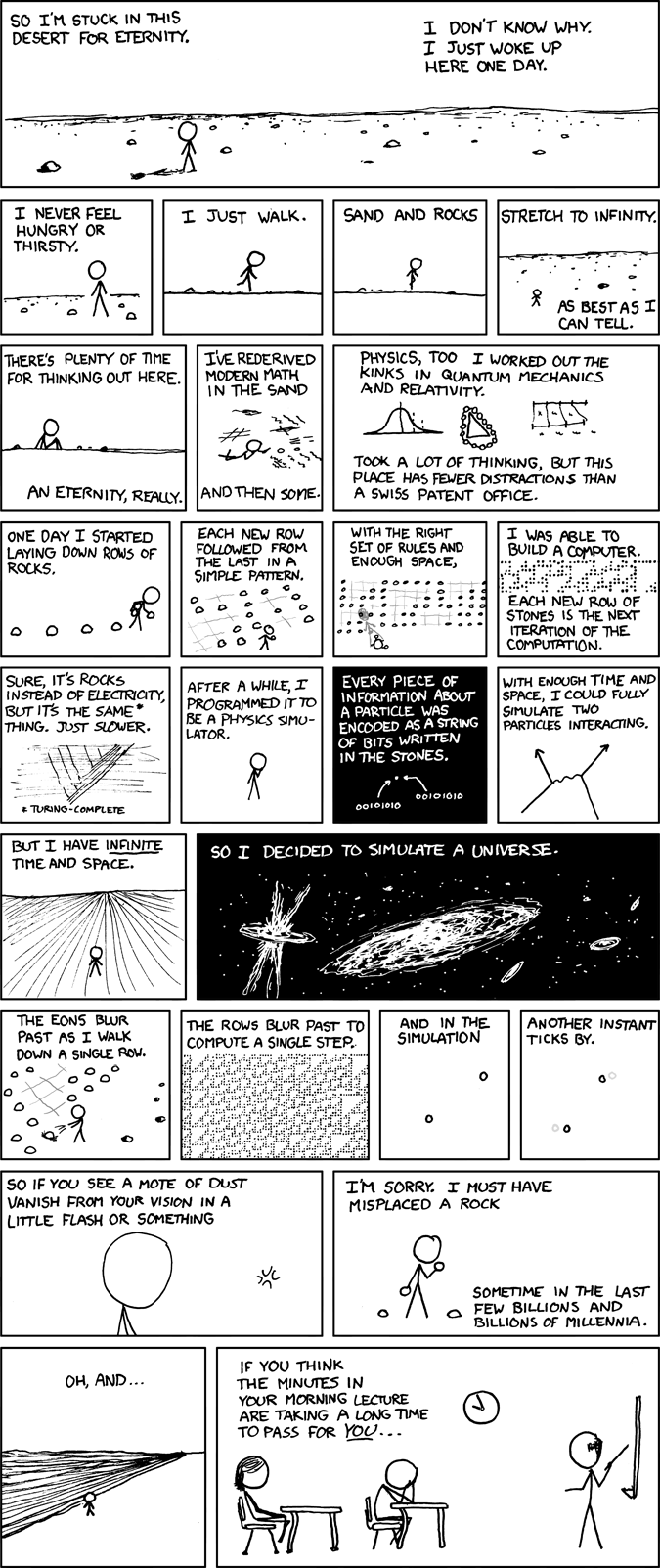
The paper in question, "Constraints on the Universe as a Numerical Simulation" by Silas R. Beane, Zohreh Davoudi and Martin J. Savage (BDS) (direct link to the PDF) builds on the ideas presented in a famous paper published by Nick Bostrom of Oxford University, entitled "Are You Living in a Computer Simulation?".

The central crux of Bostrom's argument is that if Moore's Law continues then at some point in the future we'll have enough power to simulate, to the last particle, entire chunks of the universe, from whole molecules (now/near future) to biological cells, multicellular organisms and even, in the distant future, whole cities, planets, galaxies or, at the limit, a whole universe.  He then goes on to ask what the odds are that we're living in the "one original universe" or one of the countless simulations that an advanced civilization could create - the implication being that the odds are in favour of some variant on a "Matrix" scenario - we're all probably living in a computer simulation of some description.

While this makes for a very nice bit of philosophical theorising, it's not actually definitive in any way - what's needed is some sort of test before we all start learning Kung Fu, wearing lots of black leather and attempting to escape from our digital world.  This possibility of performing such a test is the main theme of the BDS paper (which, I should point out, is well beyond my limits in many ways!)


A great many "simulations" exist in physics - in fact, it could be argued that a good definition of physics is "the search for the simplest possible way to make a universe that matches ours".  From Newtonian mechanics to relativity, string theory and dark matter, all physics really is is a series of computer programs which seem to accurately mirror the universe around us (precisely why we can develop programs like this is a different, and equally fascinating question), and the specific "program" in the BDS paper is something called lattice quantum chromodynamics (lQCD), which thankfully is easier to explain than it is to actually do!


There is no Theory Of Everything at the moment (well, string theory might be, but nobody knows yet), so physicists tend to work on their own little subsets of reality in the hope that everything can be joined up later.  lQCD is a technique that deals solely with quarks, the particles which make up most matter, but doesn't include electrons (in other words there's no chemistry in this program) and also doesn't handle time, gravity or light in any meaningful way, so it's not a complete simulation.  The basic technique is to create a lattice, a grid of points in space, and give it a starting position with all the quarks in various positions, then run the simulation to find out what happens.

It's a remarkable powerful technique, and seems to match reality extraordinarily well.  It also has another interesting feature, which is that it's very efficient - in fact, it may be the most efficient way to simulate this small chunk of reality, and this is where it gets interesting.

The universe tends to do things as efficiently as possible - for example, there aren't, as far as anyone can tell, two different systems to make gravity work and to handle the conservation of angular momentum, one necessarily implies the other, it's all tied up in the one theory.  Space and time are another example - once thought to be two entirely separate entities, Einstein's work a hundred years ago led to the realisation that they were two sides of the same coin.  So, the BDS paper asks, could the universe actually be running on lQCD?

They've taken a simple, effective form of lQCD and assumed the universe plays by exactly these rules - and then they've done the classical science thing of asking what that universe would look like if this was the case.  Obviously, yes, it will be very similar to ours, that was the whole point of developing lQCD in the first place, but this is never a guarantee - Newton's law of gravity stood for several hundred years before we found a mismatch between it and reality.

The main prediction they find is related to the "GZK cutoff", a complicated way of saying there should be a maximum energy for any cosmic ray particle hitting the Earth.  This is something that is predicted by many theories, and the big test for many of them is exactly where this cutoff applies - something which is still unclear.

The nice thing about the BDS paper is that they're able to relate the GZK cutoff to the actual spacing of the lattice in lQCD - if our universe does run on lQCD then we can potentially discover this, and even find out some of the settings under universe -> file -> preferences.

So, returning to the original question, are we living in a simulation?

We're back to philosophy here - specifically the identity of indiscernibles. Let's assume that the universe does actually use lQCD - this doesn't actually imply a simulation scenario.  Yes, it could be a simulation, but it could equally well just be "the way things are".  Mathematical models crop up all over the place; plants grow in fractal structures, cicadas mate on a prime-number based pattern of years and the Golden Ratio seems to be behind many features in the natural world, but this doesn't mean there's some sort of Grand Simulator furiously tapping away on a keyboard.

If the universe obeys a "program" such as lQCD it doesn't have to mean there was a programmer, just as the existence of Pi doesn't imply the physical existence of a mathematically perfect circle (which, ironically, is impossible under lQCD).

Long story short? I can't put it any better than the great Randall Munroe, of xkcd.com (yet again).


Thursday, 11 October 2012

StarKites Taina Review (12m)

For those who don't know, I'm a bit of a kite fanatic.  Having started on sport kites (the little hang-glider shaped things) I moved onto powerkites, then kite landboarding and have been a keen kitesurfer for many years - to the extent that I moved a few hundred miles partly based on kitesurfing opportunities (but mostly to keep the girlfriend happy, honest!)

Recently I was offered the chance to review a new brand to the UK, a company called StarKites.  To be honest, I was a little skeptical to start with, there's a lot of new entries to the kite market each year, and most of them are cheaply manufactured close-copies of the big and established names.  Not the case with StarKites however, I was pleasantly surprised though....full review follows:

StarKites Taina 12m Review

Background

I was sent a Taina 12m and Nex bar and lines which had seen around a years use as demo kit.  I have not received any incentive or gift in exchange for this review other than a loan of the kite for a couple of weeks.  What follows is my honest opinion of the kite without any bias towards or against the manufacturer or distributor - I had never flown any StarKites product before.

I weigh 10st / 65kg and I'm 5'8" / 1.75m tall.  I started kitesurfing with a Flexifoil Strike (C-kite), spent several years on a Peter Lynn Venom and for the last year and a half I've been flying Flexifoil Ions, Mk II and III.  I normally ride in fairly choppy conditions with anything up to head-high waves when there's good swell.  I'm mostly into freeride (back/front loops, carving transitions, jumps with grabs and rotations) and some wave riding which I'm trying to improve at!  I don't really go for wakestyle tricks.

Out Of The Bag

The bag itself is essentially a 50 litre rucksack with a doubled-over liner to allow it to expand and store the kite with the struts still inflated if necessary.  There's a separate outsite pocket for bar and lines, and a second zipped entry at the bottom of the bag which can be used for storing a wetsuit, towel etc.  Reasonably heavy duty cordura and plenty of zips and straps to keep things in place.  No metal components at all, so you're not going to end up with rusted zips.  It's red and black, if that kind of thing bothers you.

First impressions of the build quality on the kite are good.  The stitching is tidy, with white thread on black fabric making any problems or unravelling easy to spot.  Reinforcement patches are used in all of the high-stress areas and there is a lightweight plastic "bumper" on the center of the leading edge to give a little extra protection during ground handling.  Cordura is used on the tips of the struts to protect against wear.  All in all it's not a heavyweight, "indestructable" build, but it's perfectly adequate and results in a nice lightweight kite that should stand up well to everyday use. 

There's a simple and fairly long bridle for the main lines with a pulley on each - both pulleys were already showing signs of getting jammed with sand and salt and the pulley wheels showed wear from the line running over them rather than turning.  This will always be a problem with using pulleys on the beach, but did not seem to affect the flying characteristics in any way, from the looks of it the pulleys will "fail" pretty quickly without regular maintenance, but even then they should continue to function without any problems.


The rear lines attach to one of three different settings on the wingtip allowing you to tweak turning speed and bar pressure, with the middle setting being the ideal all-round setting as far as I'm concerned.

The Look

I'm not all that bothered about graphics and colours, as long as the kite is bright enough to make out against the sky or sea and easy for a search and rescue team to spot!  This particular model comes in brown and yellow with black leading edge and struts and some white detailing - works fine for everyday use, but in an emergency I'd like some reflective panels built into the wingtips.  The girlfriend is more into visual styling, so I'll leave the aesthetic comments to her:  "It's not brown, it's more of a bronze/burgundy.  70s retro, I like it, and the big star logo".  So there you go.

There was a tiny amount of colour bleeding visible on the white panels, but nothing to bother about unless you're planning to enter your kite into the equivalent of a classic car show.  If you want a pretty kite to show off on the wall then buy a Rok, this is for kitesurfing and it's going to get wet and stuffed in a bag at some point!


Bar & Lines

The bar and lines are generally very simple - four generic colour-coded lines (red=left, white=right) which have the power/rear line attachments reversed so you can't get them the wrong way around.  The depower strap is the simplest possible pull-pull strap arrangement and works well.  The line leaders are polyurethene coated to protect against wear - they do, however, make winding/unwinding the lines a little awkward and aren't really necessary.  The bar ends are nicely rounded, enough to safely wrap the lines without them falling off but not enough that it's likely to catch on a harness mid-kiteloop!  The bar itself seems to be carbon with a one-piece aluminium insert in the center (although it's difficult to tell without stripping the coating off!) and the hole in the middle is nicely machined, it's not going to go eating your depower line.  Most components seem to be very bog standard generic items making replacement and/or repair cheap and very easy.

Safety Systems

The primary safety is a departure from the simplicity of this kite.  It's a large plastic and metal construction with a vaguely cone shaped release - unfortunately the cone points away from you, so cold, wet and tired hands tend to slip on it, you need a reasonable grip to activate it in a hurry.  The metal components may well suffer in time - the setup I was using was already showing patches of rust in places, and the plastic has become worn leaving ragged edges where the safety line runs through.  It works, but personally I'd rather go with a simpler pin-and-loop or Flexifoil style top-hat arrangement. 
  Don't get me wrong, it works well enough, but it's a departure from the "Keep It Simple" ethos of the rest of the setup, and an unnecessary one at that.  I can't help but wonder if it's related to various international standards which require a maximum release force of X under a total pull of Y, something which has resulted in companies producing overly complicated safety systems in the past.
  Curiously, the primary safety also has "Total Weight: 35kg-90kg" embossed on it - this is confusing.  In climbing and rope access it's common to quote a safe working load and/or maximum load on equipment (something that could be useful in kitesports), but this is clearly something different.  I'm assuming it's the weight of the rider, and that it's actually rated at forces far higher than 931 Newtons (95kg) because otherwise it would have popped every time I jumped with it.  Nice try, but confusing and potentially misleading.
  The primary releases the kite onto a single front line allowing the kite to flag out and pretty much giving a 100% kill on the power - the kite inverts and falls to the ground. 
  The secondary safety is the pin-tucked-into-a-tube type - it works well enough and let's face it, it's rare to use this anyway.  The leash is fairly standard shock cord with a couple of lightweight stainless steel clips which look like they'll fail under a load of 100kg or so, which is a good thing.


In Flight

The first thing you notice is that this is a pure-bred bow kite, as far removed from a C-kite or hybrid as you can get.  If you try to fly the Taina like a C-kite you'll be very disappointed, the power generation through the window and ability to depower it by driving it to the edge are very minimal, and completely swamped by the depower range on the bar, which has so much throw it's silly.  I'd estimate that the power delivery is 70% on the bar and 30% from the kite's speed through the window, the complete reverse of a C-kite.  You don't get the explosive power and never-ending grunt, but what you do get is a kite that is very, very easy to fly in a wide range of conditions.

Close to a stall this kite still produces a lot of power, meaning the upwind performance in nasty choppy conditions is very good - if you've spent much time on a landboard you'll be familiar with getting upwind by trundling along fairly slowly, well you can do the same on the water with the Taina.  It does love a bit of apparent wind, but you don't have to build up some speed to get upwind - you can if you want, and it's still the preferred method, but you can pootle upwind while avoiding the worst of the chop if you need to.

When properly lit up the Taina performs very nicely indeed.  The power builds comfortably and the depower range means you rarely feel overpowered, although this is a double edged sword for relatively short people like myself - to fully depower the kite you've got to reach forward so far you end up in poo-stance rather than leaning back and edging against it, which isn't the ideal situation - I'd shorten the depower line and sacrifice some of the depower for a little ergonomics if this was my main kite.  People with longer arms will love it though.

I never had the chance to try the kite in flat water, but I suspect it's an absolute beast when lit up - upwind performance at speed should be very good, and low wind performance should be at least respectable - other reviews suggest it's far better.

Jumping

Smooth, easy and very forgiving.  It's not a wrench into the air as you get with some kites, just a nice firm hoist upwards with lots of float.  Again, you don't need to really wang the kite back hard, just give it a reasonably purposeful turn towards the zenith and then pull the bar in and up you go.  The quick turning speed means you don't have to crank the bar over to redirect the kite, just keep the bar pulled in with your leading hand and that's enough to bring the kite around.  I've not tried a kiteloop with it, but I'd imagine it's a fairly pleasant experience.


Stability

I managed to Hindenburg the Taina once, after messing up a jump and landing well downwind of the kite.  In relatively normal situations overflying simply results in the kite sitting back a little and drifting back into the power zone without any drama - great for newbies and wave riders who won't have to worry about catching up with the kite.

It eats gusts for breakfast - you certainly know about them through the bar feedback, but there's rarely enough of the gust transmited through the main lines to put you off balance, and again, the long throw and depower range come into their own.  My first session with the Taina was in fairly gusty conditions (~18mph gusting to the high 20s, maybe touching 30) and I never even adjusted the depower strap after I was up and moving on the first run.  Landboarders flying inland will appreciate this if they like flying LEIs.


Relaunch

I tried testing the relaunch twice, once on purpose once after wiping out. Both times the kite relaunched itself before I really had to try - very easy.

Marks out of 10

Build quality - 8
Launching - 7
Stability - 9
Safety - 5
Power - 8
Jumping - 9
Waves - 8
Freeride - 8
Freestyle - 6
Wakestyle - 4
Ease of use - 8
Newbies - 9

Overall - a solid 8.5 out of 10, a really nice kite for somebody who wants to do a bit of everything, whether on water, land or snow.  It's not the highest performance kite I've ever flown, but kites designed for pure speed, power or whatever are invariably pigs to fly.  This is aimed at the average rider (which, statistically, most of us are) and does a very good job of it.